French
  Arabic
  German
  Russian
  Dutch
Dutch  Portuguese
  Turkish
  Spanish
  Italian
Market hits $12.84 billion in 2026. Chinese exports reach 68% share. OEMs expand overseas with localized production. Lithium-ion and compact designs dominate APEX 2026.
The aerial work platform market is going through a major transformation. After two years of domestic slowdown, the industry has rebounded sharply — driven almost entirely by overseas demand.
Here is what is happening in the aerial work platform market right now.
Market Growth – Exports Lead the Recovery
The global aerial work platform market is on a strong growth trajectory. In 2025, the market was valued at $11.96 billion, and it is expected to reach $12.84 billion in 2026, with a projected CAGR of 8.3% through 2034. By 2032, the market could reach $29.38 billion.
North America currently leads with a 43.70% market share, but Asia-Pacific is the fastest-growing region.
In the first half of 2026 alone, 111,567 aerial work platforms were sold globally—a 20.6% year-on-year increase. Domestic sales in China fell 1.35% to 36,202 units, but export sales surged 35.1% to 75,365 units. Exports now account for 68% of total sales.
The message is clear: the overseas market has become the primary battleground for aerial work platform manufacturers.
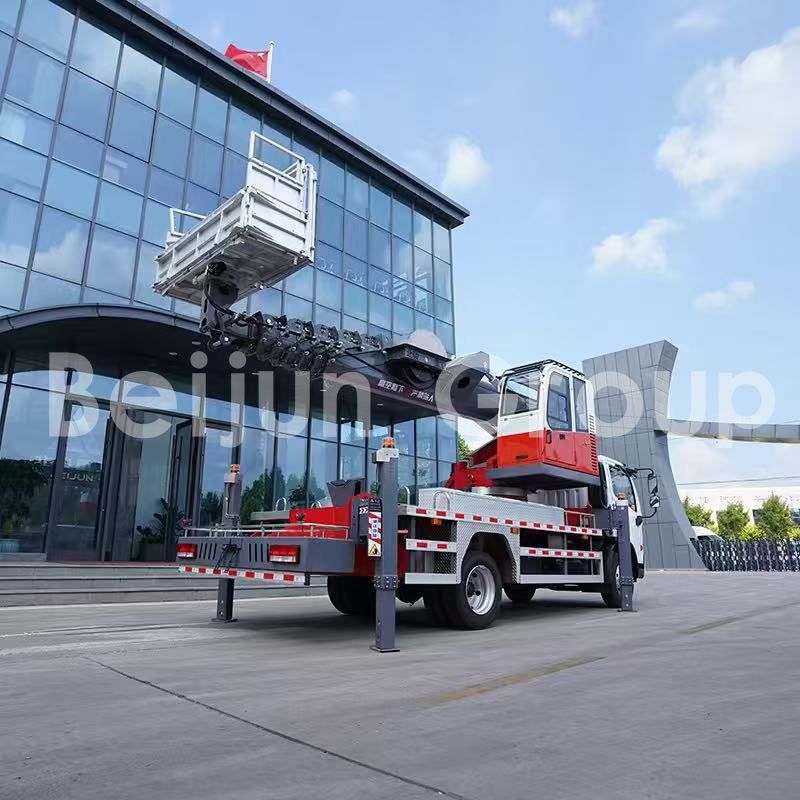
Beijun Group's Aerial Platform Product Line
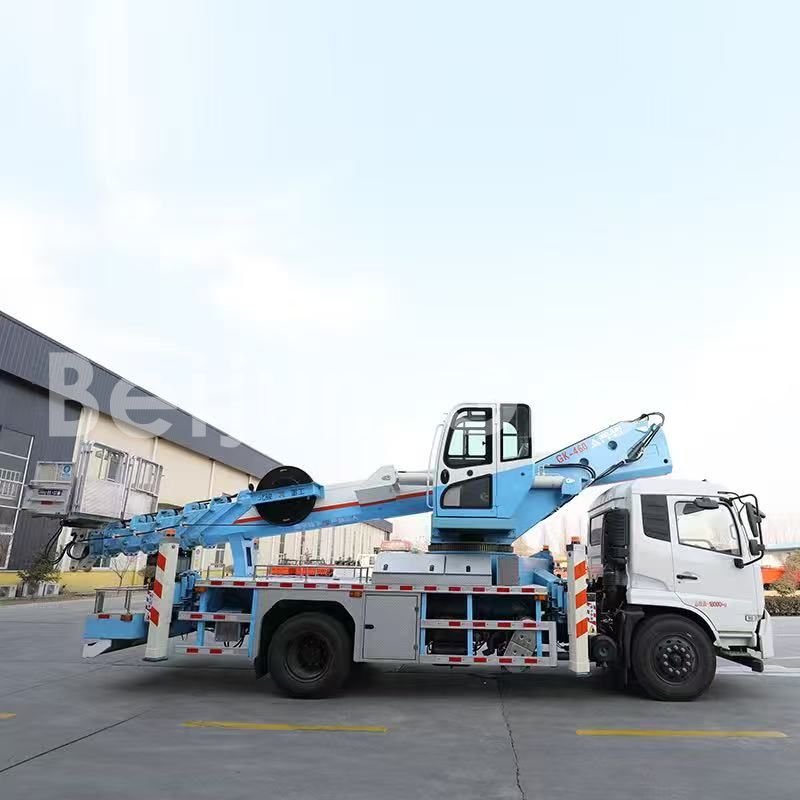
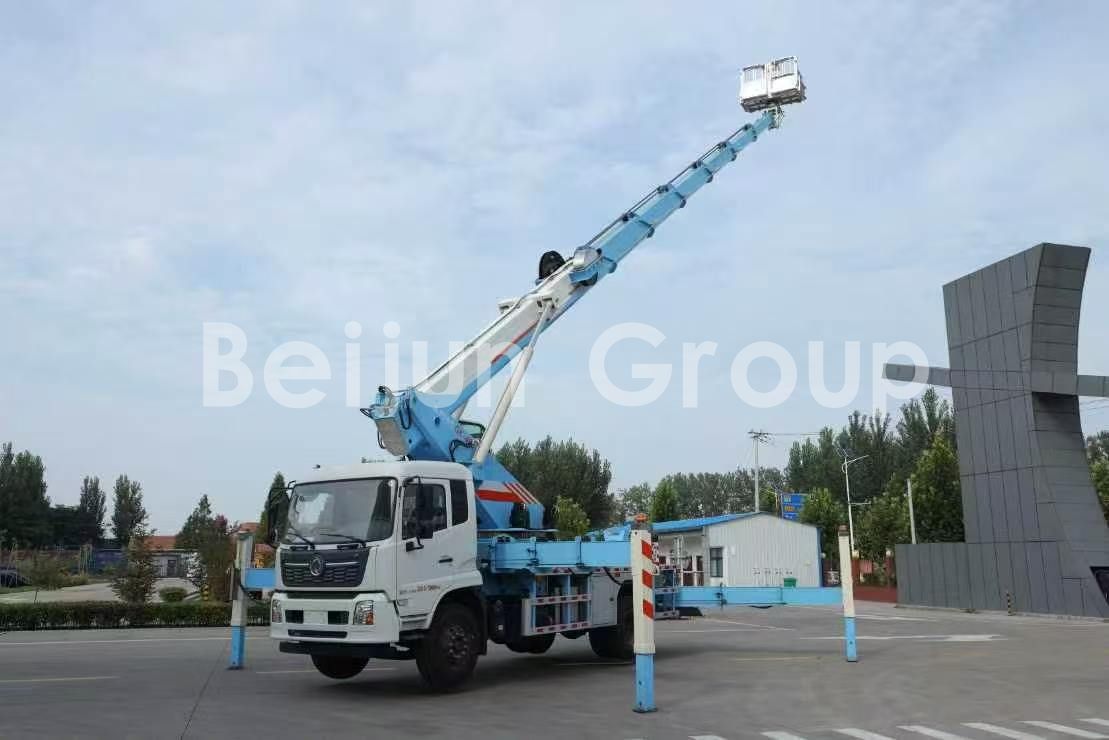
Beijun Group offers a full range of truck mounted aerial platforms spanning from 25 meters to 56 meters, covering both blue plate and yellow plate models [citation:3][citation:6]. The product lineup includes:
Blue plate models: 31.5m, 32m, 36m, and 38m – ideal for city work and municipal applications
Yellow plate models: 46m, 50m, and 56m – designed for highway, bridge, and heavy construction jobs
All Beijun aerial work platforms feature Isuzu chassis with 130-horsepower turbo diesel engines, heavy-duty rear axles, and advanced air brake systems. The company supports full customization including color, logo, and performance specifications.
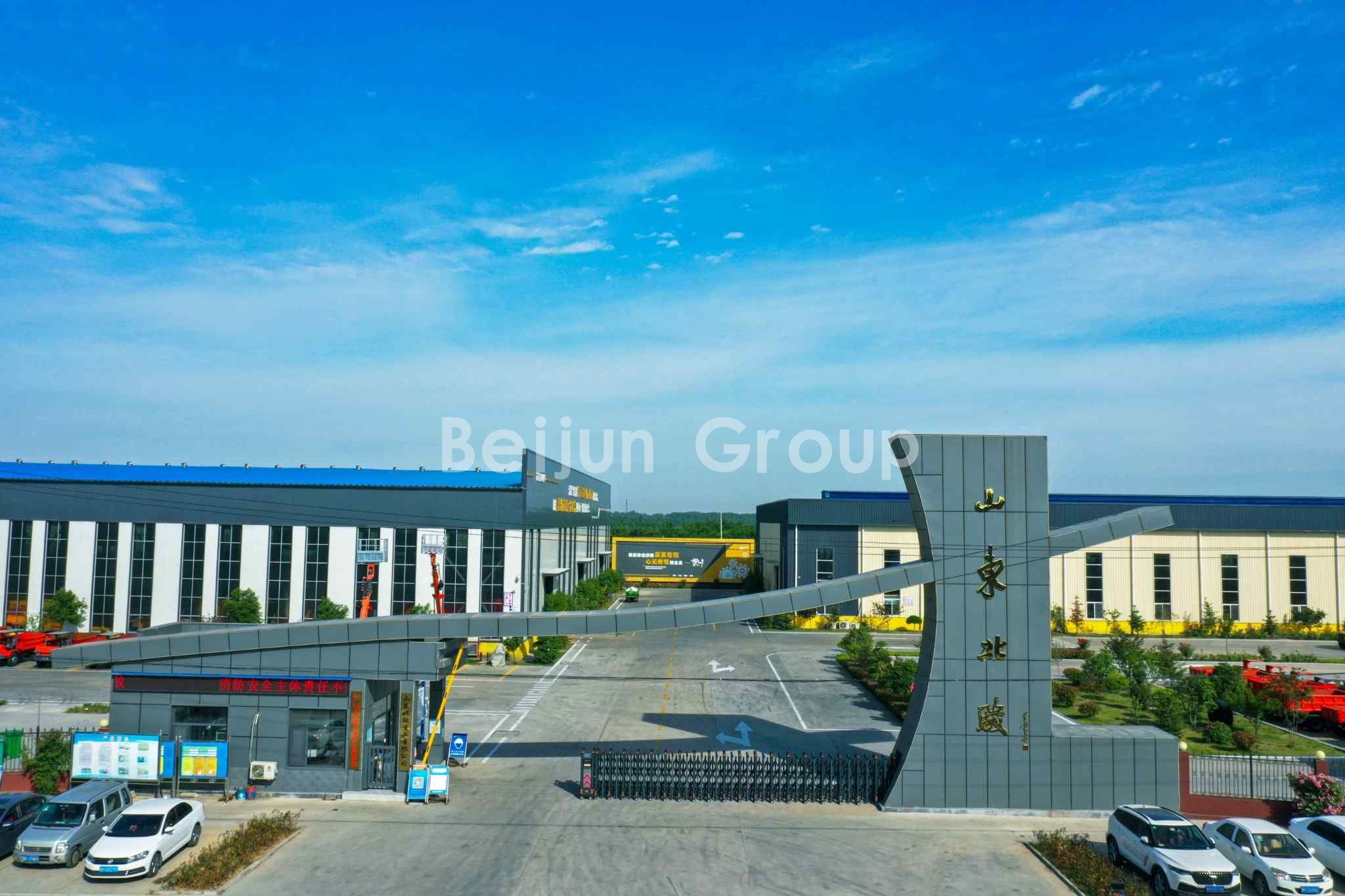
With over 500 employees including 50+ technical staff, Beijun holds ISO9001, CE, and KA certifications. Products are exported to more than 50 countries.
Industry Leaders Expand Global Footprints
Major Chinese OEMs are accelerating their international expansion with localized manufacturing and service networks.
Zoomlion Heavy Industry opened its new Hungary factory in March 2026, producing boom lifts and scissor lifts for the European market. The move is part of Zoomlion's "1+N" global manufacturing strategy, strengthening local production and service capabilities in Europe.
According to company officials, the Hungary facility represents a commitment to deeper European integration, with plans for a second phase already underway.
XCMG showcased 10 models compliant with North American standards at ConExpo 2026, covering scissor lifts, boom lifts, and mast lifts for diverse construction scenarios. At APEX 2026 in the Netherlands, XCMG highlighted its telescopic forklift series with multi-attachment capabilities for construction, logistics, and agricultural applications.
LGMG recently completed its first CE-certified products at its Mexico factory. The AR14J-2 diesel articulating boom and A13JE-2 electric articulating boom have passed strict performance and safety inspections, meeting European market standards.
Meanwhile, Tadano—the Japanese crane manufacturer—is strengthening its North American aerial platform presence following its acquisition of Manitex International in 2025. At ConExpo 2026, Tadano showcased a diverse portfolio of crawler, wheeled, spider, and truck-mounted solutions. Highlights include the AS-63HD heavy-duty boom lift with a 2,200-pound platform capacity, and the AL68 spider lift with a 68-foot working height.
Tadano's expansion reflects growing demand for specialized, high-capacity access solutions in challenging job site conditions, particularly in rough terrain and heavy-lift applications.
APEX 2026 – Four Key Trends Define the Market
APEX 2026 in Maastricht confirmed that electrification, compact design, customization, and digitalization are reshaping the industry.
Trend 1 – Electrification Is Now the Entry Ticket
Internal combustion engines still capture a large share, but electric variants are taking share rapidly. Lithium-ion batteries now deliver full-shift autonomy for scissor lifts at about 30% lower energy cost than propane equivalents. However, in price-sensitive export markets, lead-acid batteries still dominate. Lithium-ion adoption is the clear trend, but widespread uptake will take time.
Hybrid diesel-electric configurations—electric-only at idle, diesel for longer transport—are also gaining traction.
Trend 2 – Narrow Chassis + Lightweight: The New Currency
Compact manlifts with chassis widths of 1.2 to 1.6 meters and overall weight under 3 metric tons are becoming the core focus for Western European rental companies. The reasoning is practical: high building density and limited indoor working space mean narrow-body models can access warehousing, retail facilities, historical building restoration, and landscaping—scenarios where wider equipment cannot go.
Trend 3 – Application-Specific Customization Is the New Standard
Rental companies are no longer satisfied with general-purpose machines. They demand customized solutions tailored to specific job site scenarios—ultra-narrow articulated booms for warehousing, no-outrigger spider lifts for historical restoration, fast-charging electric scissor lifts for dust-free workshops.
The one-size-fits-all model is outdated. OEMs' core advantage is shifting from "whether they can manufacture an aerial platform" to "whether they can deliver the most compact, efficient solution for each segment".
Trend 4 – Digital Rental Technology Becomes Standard
IoT fleet management systems, remote diagnostics, and rental risk control hardware—GPS tracking, remote disable, staged payment management—have become standard in OEM-rental company negotiations. Digital tools like AI-based fuel consumption prediction and fault pre-diagnosis are significantly reducing after-sales operating costs.
What This Means for Buyers
If you are in the market for a truck mounted aerial platform, here is what I think matters.
Think electric. Electric models are quieter, cleaner, and cheaper to run. Lithium-ion is the premium upgrade. For price-sensitive applications, lead-acid remains a viable option.
Consider narrow-chassis models. Compact designs are becoming the standard for urban work and indoor applications. Higher utilization rates mean better return on investment.
Look at customization. Application-specific configurations are becoming the new competitive advantage. Beijun supports full customization including color, logo, and packaging.
Consider localized suppliers. Manufacturers with overseas factories and parts warehouses can reduce lead times and improve service response.
Look at rental. Rental platforms are making aerial work platforms more accessible to small and medium-sized enterprises.
Contact Beijun Group
Email: beijun@beijun-group.com
Phone: +86 17854788133
Website: www.beijun-group.com